Theater town helps little opera dream big
2026-11-26 13:55:00

One recent afternoon, two young performers stood in an open-air corner of Huichang Theater Town in Jiangxi province, singing a duet from the Gannan Caicha Opera.
Liu Haowen and Li Yunan, classmates in the Gannan Normal University's opera performance program, are part of a generation of actors betting their careers on a local art form more than 400 years old and little known outside Jiangxi.
"Honestly, I first chose it because of policy — a five-year government plan to boost local opera and the promise of a stable job at the end," Liu says. "But once I went deeper, I discovered that Caicha Opera is a really fascinating local form."
He recalls playing the role of Liu Er at a temple fair in Huichang as a primary school student. "Learning it formally later felt like fate. I kept going."
Li describes a similar shift. "When I first started, I didn't particularly like it," she says. "Then, as we began studying the vocal styles and rehearsing short plays, something woke inside me. It's in Chinese people's blood."
Their training is relentless: vocal exercises, stretches, stage practice, and voice work before the day begins. "On stage, you can't let the audience see you're nervous," Li says. "Two deep breaths, and you go." Both are still interns, on stage for about a year and a half.
Their outdoor shows are free of charge, and the audience is a mix of locals and tourists drawn to the theater town, which is the centerpiece of a broader effort.
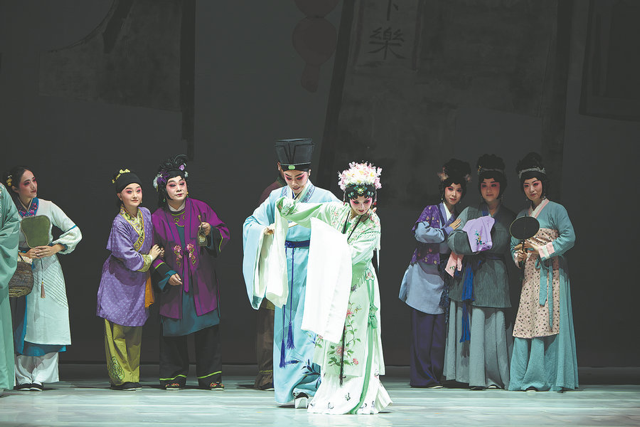
From Nov 8 to 16, Ganzhou hosted a national exhibition of outstanding opera productions selected from 13 provincial regions, with troupes from places including Anhui and Hubei provinces performing Caicha Opera, Huagu Opera and Huangmei Opera.
The Ministry of Culture and Tourism, the Jiangxi Provincial Department of Culture and Tourism and the Ganzhou municipal government hosted the event — part of efforts to implement the three-year action plan for opera revitalization (2026-2028) and to build a national platform for troupes to exchange and learn.
At the festival, Liu played the drum in Chahua Yingchun, a Huichang production selected for the program; Li was in the audience. "An actor's longing is to show real ability on a bigger stage," Liu says. "The more people in the audience, the more excited we get."
For Huichang, the festival was the latest chapter in a longer project: using its theater town, spearheaded by renowned playwright and director Stan Lai, whose family roots are here, to keep Gannan Caicha Opera — a local form combining singing, dancing and Hakka dialect — alive.
Lai, best known for Secret Love in Peach Blossom Land, first visited his ancestral hometown in Huichang in the 1990s. From 2015, he began bringing one production home each year. That commitment culminated in the opening of Huichang Theater Town, which staged a Caicha Opera adaptation of Secret Love in Peach Blossom Land as its inaugural show.
The fusion of Caicha Opera's vigorous singing and dancing with Lai's dialogue-driven play became the local troupe's calling card.
Chi Tao, a 33-year-old actor from the Huichang County Theater Development Center who plays Lao Tao, recalls taking the production to Shanghai in October 2024. The play celebrated its 40th anniversary this year.
"Very nervous, and very grateful," Chi says. "As a grassroots actor, I was suddenly on an international stage in Shanghai. I never imagined it."
The production keeps its Hakka dialect, with subtitles for audiences. He describes the fusion as a bold innovation. Both are art, but they are completely different forms. Caicha Opera is singing and dancing; the play is calm but heavy on lines. It's like two extremes, he says.
"More people now know that Gannan has its own Caicha Opera," Chi says. The genre, he noted, has a history of more than 400 years but remains a very small opera form.
"Young people used to think our opera was old-fashioned. Now, through the collaboration with Lai's play, they see it can be played with in new ways."
Attracting bigger audiences remains a challenge. At a recent traditional-opera showcase in the garden theater, attendance rose from as few as two spectators to 70 or 80, largely thanks to tour groups, he says.
"Even if only one person buys a ticket, we perform," Chi says. The troupe has added an interactive segment after each show, teaching fan movements and the signature "short-step" walk of Caicha Opera. "It's fun, and it creates an atmosphere," Chi says. "This is how we promote Gannan Caicha Opera."
Still, he is concerned about passing the tradition on. "Most young people have electronic devices," Chi says. "There will always be some who walk into a theater, but maybe fewer."
The troupe is experimenting with faster tempos and rock-infused arrangements of traditional tunes, keeping the melody and lyrics intact while speeding up the rhythm. "We are constantly innovating," he says.
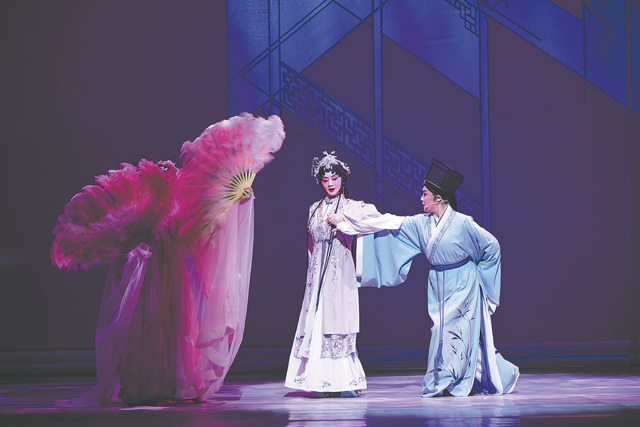
Anhui Tongling Art Theatre's original Huangmei Opera Tang Sheng and Li Niang was staged at the Huichang center, drawing many opera fans on Nov 10. [Photo by Lyu Chunhua/For China Daily]
He, a 39-year-old Huichang resident, watched a Huangmei Opera performance during the festival — his first time seeing the genre live, though he has long listened to it.
The form isn't complicated, but the performance is vivid and rich — the actors' expressions, the instruments beside the stage are all well coordinated, he says.
Cao Rui, a first-level playwright from Gansu province, said the value of bringing top-tier productions to a county lies in the immediacy of live theater.
With today's media so developed, you can see world-class, first-rate performances even from a mountain village, Cao says.
"What matters is that the theater has no walls. When you watch live, you see it with your own eyes — it is direct, and it heightens the dramatic tension. Watching on a screen and watching in a theater are two completely different things."