Jingju Lu Ming (The Call of the Deer) Dazzles Colombia’s Premier Opera Festival
2026-11-10 08:31:00
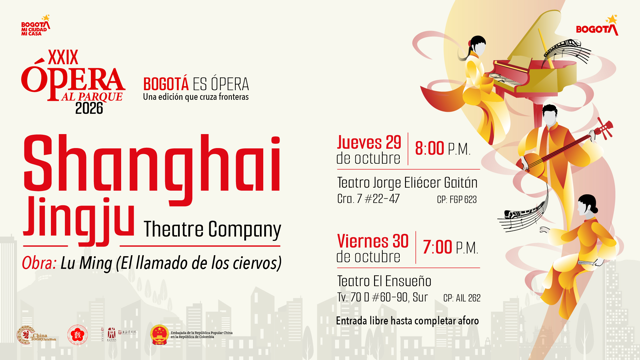
A poster for Lu Ming, a jingju production by the Shanghai Jingju Theatre Company for the 29th Ópera al Parque in Bogotá, Colombia. [Photo provided by the China Theatre Association]
Recently, under the guidance of the China Federation of Literary and Art Circles (CFLAC) and the Chinese Embassy in Colombia, and as a flagship project of the 2026 “China Today” Art Week, the China Theatre Association invited the Shanghai Jingju Theatre Company to bring its small-theatre jingju production Lu Ming (The Call of the Deer) to Colombia, where it performed at the 29th Bogotá Opera in the Park Festival.
Recently, under the guidance of the China Federation of Literary and Art Circles (CFLAC) and the Chinese Embassy in Colombia, and as a flagship project of the 2026 “China Today” Art Week, the China Theatre Association invited the Shanghai Jingju Theatre Company to bring its small-theatre jingju production Lu Ming (The Call of the Deer) to Colombia, where it performed at the 29th Bogotá Opera in the Park Festival.
Representatives of the Chinese Embassy in Colombia, and of Colombia’s Ministry of Foreign Affairs and Ministry of Culture as well as the culture authority of Bogotá, attended the premiere and jointly witnessed the charm of this national treasure of Chinese art.
Written by Zhang Chuyin and directed by Zhang Lei, Lu Ming (The Call of the Deer) was created by a young artistic team assembled by the Shanghai Jingju Theatre Company. Taking as its foundation Jataka of the Deer King, the Northern Wei dynasty mural at the Mogao Caves in Dunhuang, the production keeps to the core of jingju while integrating diverse forms of artistic expression. Young performers such as Lian Wenqing, who plays A Li, and Li Tongsheng, who plays Zi Lan, present authentic jingju vocal styles and stylised stagecraft while also incorporating puppetry, face-changing and other art forms to unfold a narrative of lingering resonance. Musically, the work makes inventive use of traditional qupai (tune patterns), combined with newly designed instrumentation and harmony, to create an auditory atmosphere of archaic simplicity and vastness.
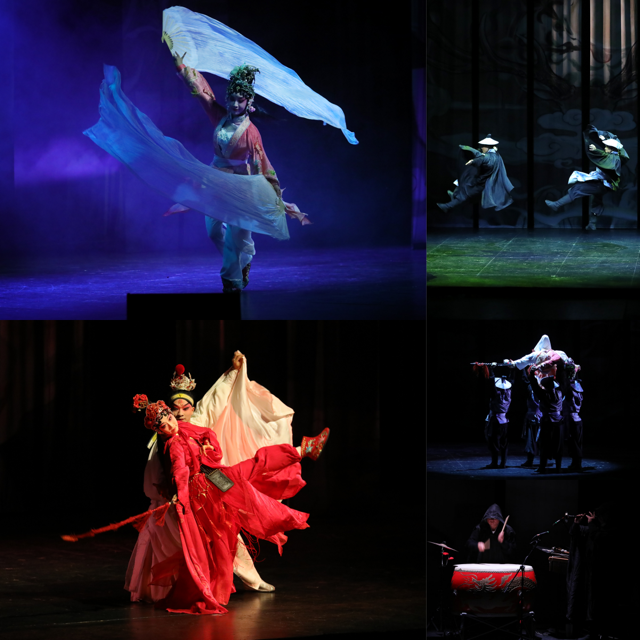
A scene from the jingju Lu Ming. [Photo provided by the China Theatre Association]
On 28 October, the festival organizing committee held a dedicated press conference for Lu Ming (The Call of the Deer). Fu Yixuan, Deputy Party Secretary and Secretary-General of the China Theatre Association; Feng Gang, Vice President of the Shanghai Jingju Theatre Company; Santiago Trujillo, Director of Culture of the Bogotá city government; David García Rodríguez, General Director of the Bogotá Philharmonic Orchestra; and members of the creative team attended the event. At the event, the Colombian soprano Patricia Guzmán sang I Love You, China in Chinese, and the atmosphere was warm and cordial. The event drew close attention from mainstream media in Colombia: 28 leading news agencies, radio and television platforms and new-media networks, including EFE and Caracol Radio, reported on it in a concentrated way, while CGTN America sent a crew for an on-site exclusive interview, promoting the series of China-Colombia cultural exchange activities in an all-round, multi-angle manner and fostering a favourable public-opinion environment overseas.
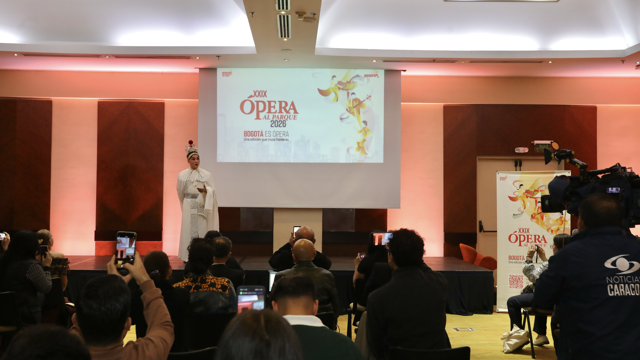
Press conference for the jingju Lu Ming. [Photo provided by the China Theatre Association]
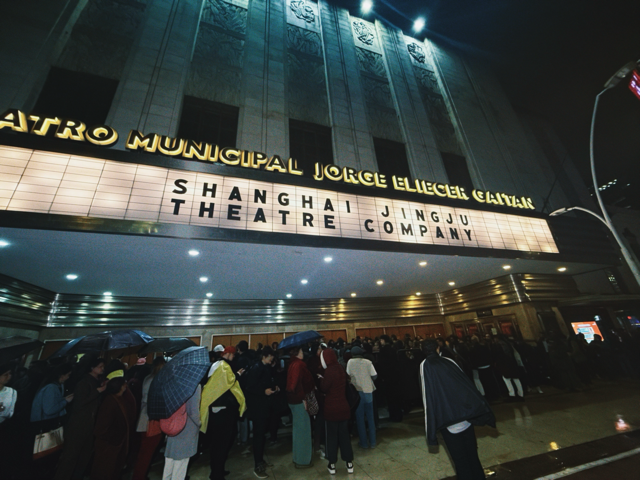
On 29 October, the first performance took place at the Jorge Eliécer Gaitán Theatre, a landmark venue in Bogotá. Built in 1940 and located in the heart of downtown Bogotá, it seats 1,745 and is the largest theatre in the city. On the day of the premiere, the performance began at eight in the evening; by five in the afternoon, many audience members had already come through heavy rain and were queuing around the building.
On 29 October, the first performance took place at the Jorge Eliécer Gaitán Theatre, a landmark venue in Bogotá. Built in 1940 and located in the heart of downtown Bogotá, it seats 1,745 and is the largest theatre in the city. On the day of the premiere, the performance began at eight in the evening; by five in the afternoon, many audience members had already come through heavy rain and were queuing around the building.
Local audiences queue in the rain for the performance. [Photo provided by the China Theatre Association]
The second performance was staged at the newly built Dream Theatre in Ciudad Bolívar, in southern Bogotá. Opened in 2021 and seating 800, the venue attracted such keen interest that many would-be audience members could not enter for lack of seats. The Colombian organisers therefore urgently set up an outdoor viewing area with a live broadcast of the stage. At the curtain call, the performers greeted the audience in Spanish, and the whole house rose to its feet, applauding and cheering for a long time and reluctant to leave.
The second performance was staged at the newly built Dream Theatre in Ciudad Bolívar, in southern Bogotá. Opened in 2021 and seating 800, the venue attracted such keen interest that many would-be audience members could not enter for lack of seats. The Colombian organisers therefore urgently set up an outdoor viewing area with a live broadcast of the stage. At the curtain call, the performers greeted the audience in Spanish, and the whole house rose to its feet, applauding and cheering for a long time and reluctant to leave.
In an interview with Xinhua News Agency, the Chilean musician Alejandro Costamayor Bela said with admiration that this was his first time seeing Chinese jingju, that the standard of the performers was stunning, and that their rigorous training, flawless stage work and expressive performance fully revealed the profound heritage of Chinese opera.
Cristian Atuesta, a lecturer at Tadeo University, observed that what moves people in jingju is the seamless fusion of all stage elements, with movement, singing, costume and music all carrying narrative and cultural meaning. This mode of expression, so different from Western opera, bears witness to the power of art to carry civilisation, and Lu Ming (The Call of the Deer) brought that unique charm to its fullest expression.
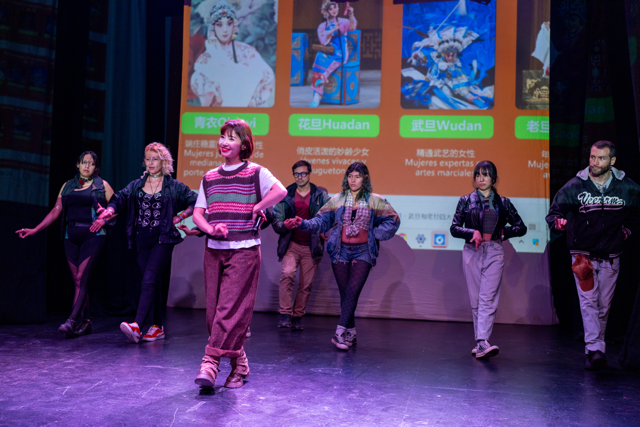
Beyond the stage, a rich and varied programme of supporting cultural exchange activities ran in parallel. Performers from the Second Troupe of the Shanghai Jingju Theatre Company visited the Gabriel García Márquez Cultural Centre in Bogotá, taking part in a “Tea and the World” cultural flash-mob event. An opera workshop was also held at the Seki Sano Theatre in Bogotá. The young performer Hu Lisha gave a talk and an immersive, hands-on teaching session under the theme “Approaching the Art of Jingju”. Chinese and Colombian theatre scholars and practitioners also held a discussion, at which Fu Yixuan and Feng Gang exchanged views with Patricia Ariza, former Minister of Culture of Colombia and a renowned playwright, and Carlos Satizábal, president of the Colombian theatre association and director of the La Candelaria theatre company, on the distinctive features of theatrical creation, artistic innovation and cultural integration.
With the performances of Lu Ming (The Call of the Deer) at its core and multi-dimensional cultural interaction alongside, the China Theatre Association’s visit presented to Bogotá the long history and rich contemporary profile of Chinese opera, enhanced mutual understanding between Chinese and Colombian artists, and opened up new space for mutual learning between the two civilizations, for consolidating the foundations of people-to-people bonds and for broadening artistic cooperation.